Smart textiles from the manufacturer. Made in Germany.

✓ Are you developing a product that requires a textile heating, sensor, or conduction function?
✓ Do you need a manufacturer that covers everything from functional design to series production?
✓ Do you want to know which textile function (heating, measuring, conducting or stimulating) is right for your application?

Embro produces functionally integrated textile components for OEMs in the medical technology, automotive, and industrial sectors and supports them in their development. Each component is manufactured according to customer specifications at our production facility in Falkenstein, Vogtland.

Discuss the project
Manufacturer of heated textiles, e-textiles and textile sensors

Smart textiles: Functionally integrated textile technology for industry and OEMs

Smart textiles and wearable textiles from the manufacturer Embro

Smart textiles heat battery housings in electric vehicles, measure pressure in orthopedic products, conduct signals via flexible textile conductors, and transmit data via embroidered RFID antennas. They replace rigid components with flexible, lightweight components that can be directly integrated into existing product designs.

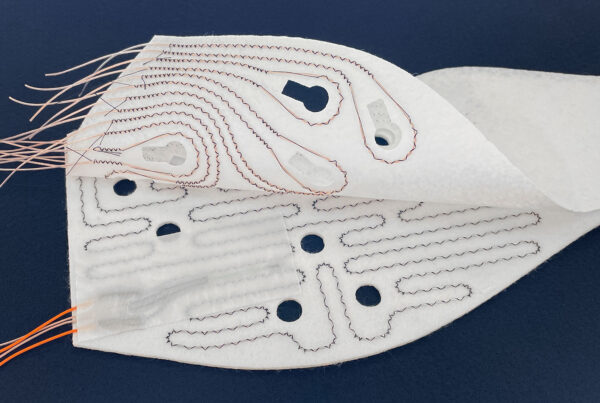
The basis for this is technical embroideryComputer-controlled embroidery machines lay conductive threads, wires and strands with high precision onto textile substrates. This results in functional components whose shape, size and conductor material can be precisely adapted to customer requirements. Embro manufactures these components for OEMs: from the first prototype to large-scale production, since 2012, at its Falkenstein site in Vogtland.

Advantages of smart textiles compared to conventional components

Light and flexible

Textile functional components weigh a fraction of rigid alternatives and adapt to any geometry.

Stretchable and kink-resistant

Smart textiles retain their function even under mechanical stress: bending, folding, stretching.

Freely configurable

Size, shape, and conductor path can be defined project-specifically using CAD/CAM. No standard dimensions, no compromises.

washable

For many applications, smart textiles can be designed to reliably withstand washing processes.

Production-ready

From the first sample to mass production: Technical embroidery enables reproducible manufacturing with consistent quality.

Integrable into existing products

Textile functional elements integrate into existing product designs without the need for housings, mounts or additional components.

Economical in production

Technical embroidery produces small and large series on the same equipment. No tooling costs, no minimum order quantities.

temperature resistant

Embro's textile heating elements operate in the range of 20 °C to over 200 °C. Micanite heating elements are available for high-temperature applications up to 400 °C and above.

What are smart textiles? Definition and distinction.

Smart textiles (also known as smart textiles, e-textiles, electronic textiles, or intelligent textiles) are textiles that perform technical functions through embroidered or integrated conductive materials, while retaining their textile properties such as flexibility, stretchability, and wash resistance. They belong to the category of technical textiles and represent a further development of functional textiles with an active electronic component.

The industry distinguishes three categories:

Passive smart textiles They react to their environment without electronic components. Examples include UV-absorbing fabrics, antimicrobial coatings, or water-repellent membranes.

Active smart textiles They integrate electronic components into the textile material. Conductive threads, wires, or fibers form sensors, actuators, or conductor tracks directly within the fabric.

Highly integrated e-textiles form complete electronic systems in textile form: sensor arrays, heating mats with defined resistance paths, flexible textile circuit boards or textile electrodes for medical applications.

Distinguishing between smart textiles and wearables

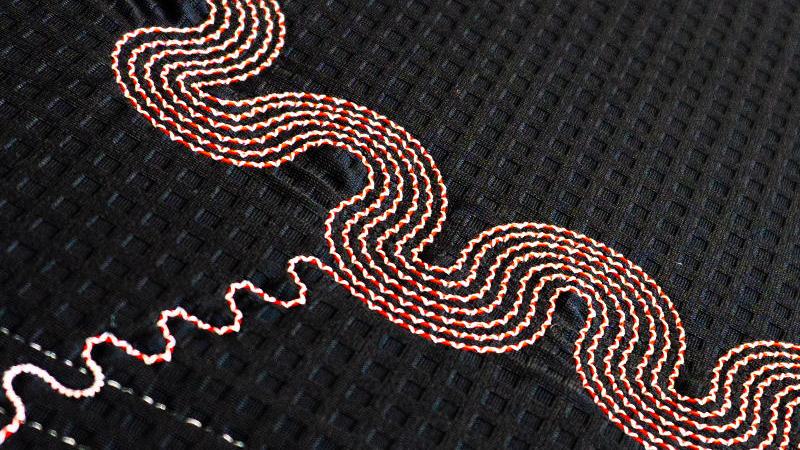
Smart textiles differ from wearable electronic devices in that... that the technical function is directly integrated into the textile structure. In a wearable device, the electronics are attached to the fabric. In a smart textile, they are integrated into the fabric itself. The functionality is achieved through conductive threads, wires, or fibers that are permanently bonded to the base material using technical embroidery or other textile processes. This is why the industry also refers to them as conductive textiles or wearable textiles.

Smart textiles have evolved in recent years from a research technology to a mass-producible industrial component. Conductive textiles are now used in medical devices, vehicles, industrial plants, and protective clothing.

What functions do smart textiles fulfill?

Flexible electric heating elements for seat heaters - flame-retardant from Embro

heat

Textile heating elements generate heat through embroidered heating conductors with defined resistance paths. The heating power can be precisely tailored to the application via the conductor material, conductor geometry, and control method. Operating temperatures range from 20 °C to over 200 °C, and up to 400 °C and more for micanite heating elements.

→ Heating elements and heating mats for industry
→ Micanite heating elements for high temperatures
→ PTC heating films: self-regulating heating elements

Intelligent safety textiles with sensors from the manufacturer Embro

Trade Shows

Textile sensors detect physical quantities such as pressure, strain, humidity, or temperature. Embroidered sensor structures enable area-wide measurements that would only be possible at specific points with conventional single sensors.

→ Textile sensors and antenna structures

Smart textiles for functional clothing from the manufacturer Embro

Lead

Flexible textile conductors transmit electrical signals to substrate materials that can be bent, folded, or stretched. Unlike rigid circuit boards, textile conductors retain their function even under mechanical stress.

→ Flexible textile leads

Textile electrodes from the manufacturer Embro as an alternative to self-adhesive and silicone electrodes

Stimulate

Textile electrodes for EMS (electrical muscle stimulation) and TENS (transcutaneous electrical nerve stimulation) replace conventional gel electrodes in therapy and medical devices. They are washable, skin-friendly, and reusable.

→ E-textiles and textile electrodes for medical technology

Textile antennas from the manufacturer Embro

Send and receive

Textile antenna structures and inductive flat coils enable contactless communication and power transfer. Embroidered UHF RFID antennas can be integrated directly into textiles without the need to glue or sew on a separate component.

→ Textile sensors and antenna structures

How are smart textiles manufactured? A comparison of processes.

The choice of manufacturing process determines which functions are feasible, which materials can be processed, and whether economical mass production is possible.

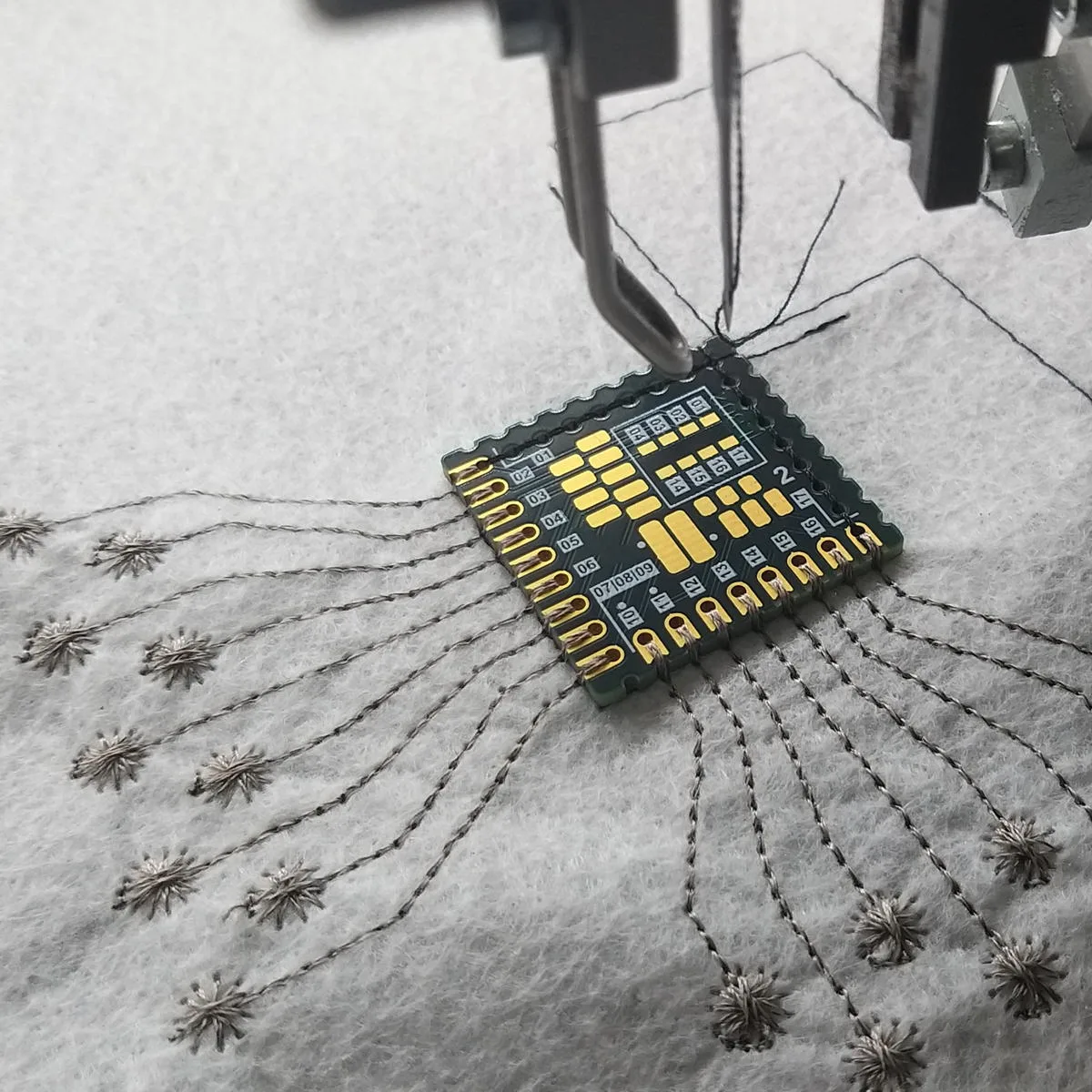
Technical embroidery – our core process – It lays conductive materials with high precision using computer-controlled embroidery machines. any carrier material. Shape, size, conductor path and conductor material can be freely defined for each project. Processable: Stranded wires from 0,04 mm diameter, stainless steel wires, silver threads, carbon fibers, coated threads, fiber optics. Suitable for small and large production runs with consistent reproducibility. Technical embroidery utilizes the same basic principle as Tailored Fiber Placement (TFP) for fiber composite components, but it also applies to conductive materials and textile substrates.

Weaving and knitting It incorporates conductive yarns directly into the textile structure. Suitable for area-based conductivity. Less suitable for precise conductor track geometries and pinpoint heating zones, because the yarn guidance is tied to the weaving technique.

Printing (conductive inks) Screen printing or inkjet printing of conductive pastes onto textile surfaces. Conductivity is lower than that of metallic conductors, wash resistance is limited, and material selection is restricted.

Laminating and gluing It applies films or flexible circuit boards to textiles. It provides high conductivity but reduces textile properties: flexibility and elasticity decrease, weight increases.

Our assessment based on practical experience: Since 2012, we have completed several thousand customer projects. From this experience, we know: Technical embroidery offers the best compromise between geometric freedom, material variety and suitability for mass production. Crucially, the manufacturing process should be determined during the development phase. Later process changes typically necessitate a complete redesign, as conductor routing, connection technology, and substrate material selection all need to be considered.

→ Technical embroidery at Embro

→ Tailored Fiber Placement (TFP) at Embro

Industries and application examples for smart textiles

Smart textiles are used as industrial functional components in medical devices, vehicles, industrial plants, protective clothing, and transport solutions. The most common applications are textile heating elements for thermal management, textile sensors for condition monitoring, textile electrodes for therapy devices, and textile antenna structures for contactless identification.

Medical technology and therapy

Textile EMS and TENS electrodes replace gel electrodes in therapy devices. Textile coil mats generate magnetic fields for medical applications. Washable, skin-friendly, reusable.

→ E-textiles for medicine
→ Textile electrodes
→ Highly flexible magnetic field coils

Automotive and e-mobility

Textile heating mats for battery thermal management keep the cell temperature within the optimal operating range. Seat heaters, steering wheel heaters, and interior heating elements are also available in textile versions.

→ Battery heating for lithium-ion batteries
→ Heating elements for automotive and mobility
→ Series production of heating mats for commercial vehicles

Industry and mechanical engineering

Heating sleeves for pipelines, heating mats for containers and shelters, control cabinet heaters. Custom geometries instead of standard dimensions, operating temperatures up to over 200 °C.

→ Heating mats for containers, shelters and residential modules
→ Frost protection with pipe tracing
→ Heating sleeves from the manufacturer

transportation and logistics

Heated food transport containers, underfloor heating in transport vehicles, heating solutions for motorhomes and caravans.

→ Heated food transport containers
→ Underfloor heating solutions in transport vehicles
→ Heaters for motorhomes and caravans

Sports and Sensory

Textile pressure sensors detect stress in real time. Humidity sensors monitor environmental conditions. Applications range from cycling to industrial condition monitoring.

→ Textile pressure sensors in cycling
→ Humidity monitoring sensors

Do you have a specific application in mind? Discuss the project

From idea to series: This is how a project works at Embro

1. Requirements analysis Together we define the geometry, function, conductor material, substrate material, and target quantity. In this step, we also clarify approval requirements and the customer's downstream processing.

2 CAD design Our developers will work with you to create the digital layout of the textile functional element. The CAD/CAM design defines the conductor path, resistance paths, connection points, and tolerances.

3 sample series Initial samples are created on our embroidery machines in Falkenstein in the Vogtland region. You then validate these samples in your own test environment and production process.

4 Optimization Based on your test results, we adjust the material, layout, or connection technology. This step is repeated until the specification is approved.

5 Series production Production in Fakenstein/Vogtland ensures consistent quality and repeatability. Every component is manufactured on the same equipment and with the same parameters as the approved prototype. Since 2012, we have successfully transitioned several thousand projects from prototype to series production.

What are the key factors in the selection process? Technical decision criteria for smart textiles.

For engineers and technical buyers specifying a smart textile component, five criteria are crucial.

conductor material

The choice of conductor material determines conductivity, corrosion resistance, biocompatibility, and cost. Embro processes, among other materials, stainless steel wire (corrosion-resistant, suitable for industrial applications and outdoor use), silver threads (highest conductivity, relevant for sensors and medical technology), and carbon fibers (lightweight, tensile strength, suitable for structural integration).

support material

The backing material determines not only the feel but also the suitability for fabrication, washability, and further processing in the customer's workflow. Embro processes backing materials ranging from polyester and aramid to medical nonwovens. The selection depends on the intended application, regulatory requirements, and the customer's downstream processing.

The most common misconception in initial projects is that the substrate material is treated as a subsequent step. In practice, we recommend defining the substrate material together with the functional design, because it directly influences washability, fabrication, and connection technology.

Temperature range

Embro's textile heating elements cover an operating temperature range from 20 °C to over 200 °C. For high-temperature applications up to 400 °C and above, Embro uses micanite heating elements, which can withstand temperatures at which textile substrates reach their limits.

wash resistance

The achievable wash resistance depends on the conductor material, the substrate material, and the connection technology. For applications requiring regular washing (medical textiles, clothing), we specifically select materials and connection technologies for wash resistance. Wash resistance is generally not a factor for industrial heating elements and process heat applications.

Relevance for admission

Different standards and approval requirements apply to medical devices, automotive products, and occupational safety equipment. Embros heating tapes and heating elements are VDE-certified. UL certification is currently underway. We support customers with documentation and quality assurance for the respective industry standards.

→ VDE-certified heating tapes and heating elements

Smart textiles for improved workplace safety from the manufacturer Embro

Smart textiles in occupational safety

Textile sensors in protective clothing capture body data in real time (body monitoring): fatigue levels, posture, skin temperature, and heat exposure. The sensors are integrated directly into the fabric and do not require a separate device. From detecting fatigue to warning of hazardous substances, smart textiles provide a measurable increase in safety in occupational safety.

Flexible electronics & printed circuit boards from the manufacturer Embro

Flexible electronics and textile printed circuit boards

Embro embroiders circuits and conductive traces onto flexible substrates. Dimensions, flexibility, temperature resistance, and robustness are defined by the customer. The CAD design is created once, and then the embroidery machines produce textile electronic components with high productivity and repeatability in small and large production runs.

Smart textiles for your project: The next step

You now know what functions smart textiles fulfill, what manufacturing processes exist, and what is important when selecting materials.

The next step: Discuss your specific requirements.

In a brief initial consultation, we will jointly clarify which process and materials are suitable for your application, what a sample process looks like, and what timeframe you can expect.

Afterwards, you'll know whether a textile solution is technically and economically viable for your project and what the first steps are. No obligation, no sales pitch.

Let's have a chat

If you would like to see what smart textiles look like in practice first: Read how radiolucent patient warming systems arise, how Battery heaters for lithium-ion batteries have been created for the automotive sector or how Textile coil mats in medicine and therapy be used.

Frequently asked questions about smart textiles

The most important questions that product developers and technical buyers ask us about smart textiles. Do you have a question that isn't answered here? Contact us directly.

What are smart textiles?

Smart textiles (also known as smart textiles, e-textiles, or intelligent textiles) are textiles with integrated technical functions. Conductive threads, wires, or fibers are incorporated into the base material using technical embroidery or other textile processes. These textiles heat, measure, conduct, or transmit without losing their flexibility and elasticity. In industrial contexts, they are used as heating elements, sensors, electrodes, or conductive traces in products from OEM manufacturers in the medical technology, automotive, and mechanical engineering sectors.

What is the difference between smart textiles and wearables?

In a wearable device (for example, a smartwatch), the electronics are a separate component attached to or mounted on a substrate. With smart textiles, the technical function is integrated directly into the textile structure. The conductive materials are part of the fabric, not glued or sewn on. This preserves the textile properties: the material remains flexible, stretchable, and in many cases, washable.

What is the difference between smart clothes and smart textiles?

Smart clothes (also called intelligent clothing or smart clothing) refer to garments with integrated electronics for end consumers, such as heated jackets or sports shirts with heart rate monitoring. Smart textiles in an industrial context go further: They include functional textile components such as heating elements, sensors, electrodes, and conductive traces, which OEM manufacturers integrate into their own products. Embro produces these industrial smart textiles, not the end-consumer products.

What are active smart textiles?

Active smart textiles integrate electronic components directly into the textile material. Unlike passive smart textiles (for example, UV-absorbing fabrics or antimicrobial coatings), active versions contain sensors, actuators, or conductive traces that process electrical signals. Examples include textile heating elements with defined resistance paths, textile pressure sensors for orthopedic applications, or EMS electrodes for therapeutic devices.

What manufacturing processes exist for smart textiles?

The four common methods are technical embroidery, weaving/knitting, printing with conductive inks, and laminating/bonding. Technical embroidery offers the greatest freedom in terms of geometry and material selection: strands from 0,04 mm, stainless steel, silver, carbon, and other materials can be applied to any substrate. The method is suitable for prototypes and large production runs alike.

For which industries are smart textiles suitable?

Industrial applications for smart textiles are found primarily in medical technology (textile electrodes, coil mats for therapy devices), the automotive sector (battery heating, seat heating, interior heating elements), mechanical engineering (process heat, heating sleeves, control cabinet heating), and transport and logistics (underfloor heating in vehicles, heated transport containers). Further areas of application include occupational safety, sports, and smart living.

How does the development of a smart textile component proceed?

The typical process comprises five steps: requirements analysis (geometry, function, material, quantity), CAD design of the textile functional element, prototype production for validation in the customer's process, optimization based on test results, and series production. At Embro, all steps take place at the Falkenstein site in the Vogtland region. The timeframe from the initial consultation to the approved series production depends on the complexity of the application and the regulatory requirements.

Can Embro also produce small batches?

Embro manufactures smart textiles in small and large series on the same embroidery machines. CAD/CAM-controlled production eliminates tooling costs and requires no minimum order quantities for initial orders. This makes the process suitable for prototypes, first samples, and pilot series before a customer transitions to large-scale production.

Smart Textiles & Wearable Textiles Made in Germany

Embro designs and manufactures smart textiles and wearable textiles according to your individual specifications for further processing in your product.

With our embroidery technology, you particularly benefit from these advantages:

✓ Embroidered sensor areas for various parameters (pressure, movement)
✓ Smart textiles with individual shape and size
✓ Integration of additional sensors (e.g., temperature, humidity), LEDs, switches, and much more
✓ Wide selection of flexible carrier materials for your application
✓ Electrical conductors, heating conductors, light guides, coated threads, hoses for intelligent functions
✓ Particularly fine strands down to 0,04 mm and sensitive materials are possible
✓ Efficient and cost-effective production in large and small series

Do you have an innovative idea for smart textiles? We would be happy to realize it with you!

Contact us

Are you interested in Smart Textiles & Wearable Textiles?

Learn more about different aspects in our articles:

Flexible connecting elements as an elastic embroidery pattern with double wireMedical TechnologyNewsSmart textilesFlexible textile leads for smart textiles, e-textiles and digital health
August 20, 2025

Flexible textile leads for smart textiles, e-textiles and digital health

Textile leads for smart textiles & e-textiles ► conductive connection structures for data & energy ► flexible thanks to bends & curves ► customized ► Made in Germany
EL Wires (cross-section) for technical textiles that glow in the dark, from the manufacturer EmbroNewsSmart textilesEL Wires: Technical embroidery makes smart textiles shine
17 January 2024

EL Wires: Technical embroidery makes smart textiles shine

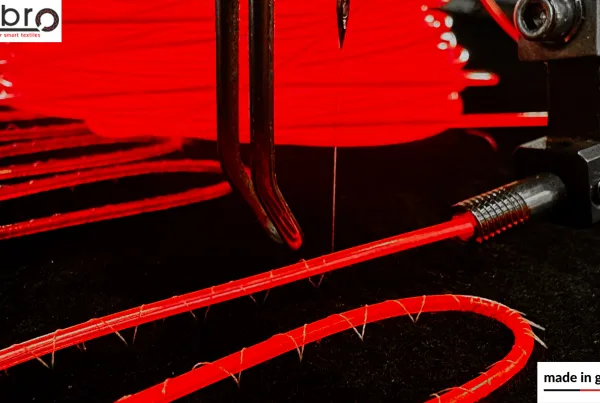
EL Wires ► Luminous Smart Textiles through Technical Embroidery ✓ Flexible ✓ Durable ✓ Energy-efficient ✓ Safe
Embro: Specialist for Smart TextilesHeating elementsNewsSmart textilesCompanyWe embroider innovations
March 14, 2023

We embroider innovations

Innovation is our daily business ► We turn your ideas into great products ✓ Heating elements ✓ Textile sensors ✓ Smart textiles
Seat, interior and cabin heating - heating elements for automotive & mobility from the manufacturer EmbroHeating elementsNewsSmart textilesHeating elements for automotive & mobility in series production | B2B
February 3, 2023

Heating elements for automotive & mobility in series production | B2B

Highly sought after: Heating elements for interior design ► easy processing ✓ flexible & kink-resistant ✓ homogeneous heat
Flexible electric heating elements for smart textiles from EmbroHeating elementsMedical TechnologyNewsSmart textilesSmart textiles enhance comfort for smart living
30 January 2023

Smart textiles enhance comfort for smart living

We encourage manufacturers of smart living products ► diverse functional integrations ✓ heat ✓ vibration & much more ✓ for your product development
Flexible connecting elements as an elastic embroidery pattern with double wireNewsSmart textilesFlexible connectors: sought-after all-rounders
12 January 2023

Flexible connectors: sought-after all-rounders

Top: Flexible conductive tracks in smart textiles ► for data transfer & electrical power supply ✓ reliable ✓ in sports & leisure

All Products & Embro Technologies

Heating textiles: Flexible electric heating elements & heating mats for industry from Embro

Heating elements & heating mats

Textile sensors & antenna structures from Embro

Textile sensors & antenna structures

Functional technical textiles for medical devices from Embro

E-textiles
for medicine

Tailored Fibre Placement for fiber composite components from Embro

Tailored Fiber Placement for Fiber Composite Components