Textile sensors from the manufacturer. Made in Germany.

✓ You need a sensor that adapts to flexible, curved or textile surfaces?
✓ You are looking for a manufacturer who Sensor layout, material selection and series production from a single source delivers?
✓ You want to know if a textile sensor (pressure, temperature, humidity) or a textile antenna (RFID, NFC) is the right solution for your application?

Embro collaborates with OEM manufacturers in the medical technology, automotive, and industrial sectors to develop textile sensors and antenna structures. Each sensor component is manufactured to your specific requirements at our production facility in Falkenstein, Vogtland.

Discuss the project
Manufacturer of textile sensors, RFID antennas and signal transmission

Textile sensors: Sensor technology and antenna structures on textile substrates for industry and OEMs

Textile antennas from the manufacturer Embro

Textile sensors are sensors whose measuring elements are integrated directly into a carrier textile, rather than being mounted on rigid substrates such as circuit boards or films. Various methods are used in the industry: weaving, printing with conductive inks, or coating. Embro relies on technical embroidery, in which conductive threads and wires are applied to the carrier material using CAD software.

The sensors detect physical quantities such as pressure, temperature, humidity, and strain. The mechanical properties of the textile are retained: flexibility, elasticity, and wash resistance, even when the material performs a technical function. Embro supplies textile sensors as semi-finished products for further processing in your product. Textile sensors belong to the field of smart textiles and there form the segment of measuring and identifying functional components.

Contact us now!

Textile sensors and antennas that we manufacture for you

Textile pressure sensors from the manufacturer Embro

Textile pressure sensors

Textile pressure sensors detect pressure distributions with spatial resolution by measuring changes in resistance or capacitance of conductive structures. adapt to curved and deformable surfaces, where conventional foil sensors fail.

Areas of Application: Ergonomic optimization in seating and lying systems, contact and safety mats, pressure analysis in sports, medical technology.

Application example: Pressure sensors in cycling

Textile humidity sensors

Capacitive or resistive measuring principles detect moisture via conductive sensor structures on textile substrates. The sensors are flexible, cost-effective and available in various sizes.

Areas of Application: Production environments with humidity control, care textiles, building technology.

Application example: Flexible sensors for humidity monitoring

Textile strain sensors

Strain sensors detect mechanical deformations by measuring the change in length of conductive paths in textiles based on resistance. They are used wherever structural changes need to be continuously monitored.

Typical applications: Structural monitoring in fiber composite components (damage sensing), motion detection in medical and sports products.

Damage sensing for transport protection and battery housing

Intelligent safety textiles with sensors from the manufacturer Embro

Textile RFID antennas (UHF)

UHF RFID antennas can be integrated directly into a carrier textile as embroidered conductor structures. They enable the contactless identification over distances of several meters and withstand industrial washing processes.

Applications: Laundry management, condition monitoring of fire protection clothing, theft protection for truck tarpaulins and transport covers.

Embroidered textile inductive sensors from the manufacturer Embro

Textile NFC antennas and inductive coils

NFC antennas on temperature-resistant substrates function in the range of 150 to 250 °C, where conventional foil tags fail. Embroidered antenna structures on aramid or fiberglass fabric retain their shape and function under continuous heat exposure.

Applications: Short-range data transmission in high-temperature environments, inductive sensors, medical devices, smart living.

Sensor arrays with conductive traces

Textile sensor arrays combine multiple measuring points with embroidered conductive traces in a semi-finished textile product. The conductive trace routing, the number of measuring points, and the connection geometry are designed project-specifically using CAD.

Applications: Spatially resolved pressure distribution measurement, safety and contact mats, medical sensor mats, industrial condition monitoring.

Why textile sensors instead of conventional sensors?

Textile sensors offer advantages over conventional film or circuit board sensors. Advantages in applications include flexibility, low weight, wash resistance, or seamless integration into existing textile products. required. However, where pinpoint absolute value measurement under laboratory conditions is required, conventional sensors remain the more accurate choice.

Criterion Textile sensor (embroidered) Foil sensor PCB sensor
Geometry adjustment Any shape, curved, stretchable Planar, limited flexibility Starr
Weight Very easy Slightly schwer
wash resistance Yes (depending on the material combination) Limited No
Wearing comfort (skin contact) High Medium Not suitable
Customizability Sewable, coverable, laminateable Adhesive Screwable, solderable
Serial production capability CAD/CAM-controlled, scalable High High
Measurement accuracy (absolute value) Application-dependent High Very high

If your sensor is to be integrated into a product that will be washed, bent, or worn on the body, the textile version is the more technically sensible solution. In an initial consultation, we will clarify which option is suitable for your application.

Our manufacturing process: Technical embroidery for textile sensors

Various processes are used to manufacture textile sensors: technical embroidery, weaving, knitting, printing with conductive inks, and coating. Technical embroidery allows for the CAD-controlled placement of conductive threads and wires in any geometry, thus offering the highest combination of geometric freedom and mass production capability.

At Embro, conductive threads, wires, and strands are applied to the substrate using CAD software. Shape, size, conductor material, and sensor layout are freely definable for each project. More about our process: Technical embroidery

Why technical embroidery and not printing, weaving or coating?

Based on our experience with thousands of customer projects since 2012: The mechanical robustness of the connection between the conductor and the textile is the decisive factor for long-term stability. Printed conductor tracks delaminate with repeated bending. Embroidered conductors are an integral part of the textile structure.

Process Geometry freedom wash resistance Variety of materials classification
Technical embroidery (our procedure) Up: any curves, branches, connection points High: The ladder is mechanically connected to the textile. High-quality materials: stainless steel, silver, carbon, ultra-fine strands Best compromise between precision, material variety and scalability
Weaving / Knitting Low: primarily linear structures High Means: Yarns must be suitable for weaving/knitting. Suitable for uniform conductivity across the surface, not for precise sensor geometries.
Printing (conductive inks) Medium: planar, limited in 3D Limited: Detachment under mechanical stress Low: only inks/pastes Cost-effective for simple structures, delamination occurs during bending or washing.
Coating Low: only full surface Limited: Abrasion Medium Useful for shielding or antistatic applications, not for defined measuring points.

Materials and specifications

Conductor materials we process:

Stainless steel wires, silver-coated threads, carbon fibers, and coated copper strands in ultra-fine diameters. Other materials available upon request.

Carrier materials:

The choice of material depends on the requirements of your application.

  • Polyester It is suitable as a cost-effective standard material for many industrial applications.
  • Aramid fabric It is used when heat resistance is required.
  • Medical nonwovens offer biocompatibility and skin contact compatibility for therapy and diagnostic products.
  • Fiberglass fabric We use it for integration into fiber composite components and at temperatures above the operating range of standard textile materials.

Performance data: project-specific instead of a flat rate

Key characteristics such as wash resistance, temperature range, and conductivity depend on the combination of conductor material, carrier textile, and connection technology. General data sheets would be misleading because the values ​​change with each material combination. Therefore, we define the specification together with you in the project and validate it against your samples.

The choice of material determines not only the electrical function, but also the further processing possibilities in your process. An aramid-based sensor can be used at 200 °C, but requires a different assembly process than one based on polyester nonwoven fabric. We define the conductor and carrier materials together with your assembly process, not in isolation.

A guideline that applies across industries: Textile NFC antennas on temperature-resistant substrates function in the range of 150 to 250 °C. Conventional foil tags fail in this range.

Industries in which our textile sensors are used

Embro's textile sensors and antenna structures are used as industrial functional components in various sectors. The most common applications include pressure sensing for medical devices, RFID identification and tracking in logistics and occupational safety, seat occupancy detection in the automotive industry, and structural monitoring in fiber composite components.

Medical technology and therapy

Textile pressure sensors in hospital beds and positioning systems for pressure ulcer prevention. Textile electrodes for EMS/TENS therapy devices. Biocompatible, washable, and reusable sensor components for medical devices and wearables.

More about our e-textiles for medicine | Textile electrodes

Mobility and vehicle technology

Sensors for seat occupancy detection. Textile heating mats for battery thermal management with integrated overtemperature protection.

Heating textiles and heating mats for automotive applications

Occupational safety and personal protective equipment

Temperature sensors in protective clothing for heat warnings. Humidity sensors in workwear. Strain sensors for recording posture and movement patterns (body monitoring). The sensor structures are integrated directly into the fabric and can be connected to the customer's evaluation electronics.

Logistics

UHF RFID tags on textile carriers for automated identification of workwear after washing. Condition monitoring of fire-resistant clothing throughout its entire lifecycle. In the area of ​​valuables transport and load securing: textile-integrated theft protection for truck tarpaulins and transport covers.

Fiber composite and structural monitoring

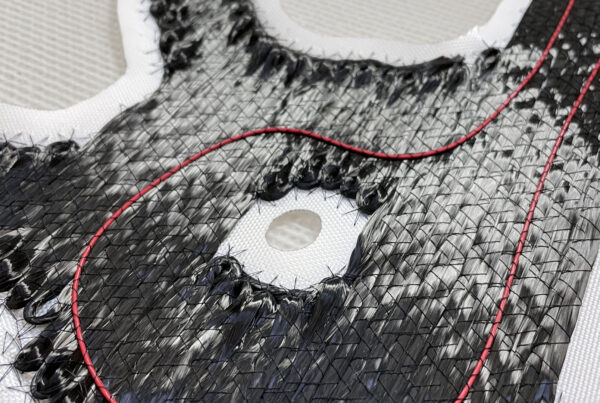
Textile sensor mats for damage detection in CFRP components. Sensors for impact monitoring in transport protection and battery housings. The sensor structures are integrated directly into the fiber preforms and detect damage in real time.

Damage sensing for transport protection and battery housing

This is how a sensor project at Embro works

1

Requirements analysis

Measurement parameter, geometry, material, quantity

2

CAD layout

Conductor routing, connection points, integration

3

Sample series

Validation in your product and process

4

optimization

Adjust material, layout, and connection technology

5

Serial Production

Falkenstein/Vogtland, CAD/CAM, Made in Germany

Embro: Project experience in textile sensor technology

Embro GmbH, based in Falkenstein/Vogtland, manufactures custom sensors, antenna structures, and heating elements for industrial and medical applications using technical embroidery. Together with our customers, we develop functional textile components from initial concept to series production. 100% manufacturing in Germany.

Thousands of customer projects since 2012. Customers from medical technology, automotive, occupational safety, logistics and fiber composites. Production runs from 500 to 100.000 units on the same equipment.

Application example: Textile pressure sensors in cycling

Embro manufactures textile pressure sensors for Velometrik GmbH, featuring 388 pressure measurement points in a three-layer textile construction. The sensors are sewn into Velometrik's SmartCover and measure pressure distribution on bicycle saddles for bike fitters and physiotherapists. Conductive threads are embroidered onto the base fabric in a defined pattern; a pressure-sensitive intermediate material changes its electrical resistance under load. Embro has been producing these sensors in series since the project began. Velometrik envisions further applications in healthcare and medicine, including pressure ulcer prevention, prosthesis fitting, and gait analysis.

For application example

Certifications:

  • Quality management system according to DIN EN ISO 9001, certified by TÜV Süd (first certified in 2014)
  • Heating elements, heating mats and heating tapes VDE-tested according to DIN EN 60335-1 (VDE 0700-1):2024-07, certificate no. 40061865
  • UL certification in process

Textile sensors for your project

Do you have a specific sensor application? In a brief initial consultation, we will clarify which sensor type and materials are suitable for your application, what a sample process looks like, and what timeframe you can expect.

No sales pitch. You will receive a technical assessment.

Discuss the project

Frequently asked questions about textile sensors

The most important questions that product developers and technical buyers ask us about textile sensors. Do you have a question that isn't answered here? Contact us directly.

What are textile sensors and how do they work?

Textile sensors consist of conductive materials (threads, wires, strands) that are integrated into a carrier textile using technical embroidery or other textile processes. Depending on the sensor type, they detect physical quantities such as pressure, temperature, humidity, or strain by measuring changes in the electrical resistance, capacitance, or inductance of the conductive structure when the measured quantity is applied. Unlike film or circuit board sensors, the textile carrier material remains flexible, stretchable, and in many cases, washable.

Which pressure sensors are suitable for use in textile applications?

For textile applications, resistive and capacitive pressure sensors are particularly suitable, with their measuring structure embroidered directly onto a carrier textile. These sensors detect pressure distributions across the entire sensor surface rather than just at individual measuring points and adapt to curved or deformable surfaces. Typical applications include ergonomic optimization in seating and lying systems, safety mats, and medical applications such as pressure ulcer prevention.

Are textile sensors washable?

Wash resistance depends on the combination of conductor material and carrier textile. Embroidered sensor structures are a mechanically integral part of the textile and therefore significantly more robust than printed or glued conductor tracks, which can delaminate when bent or washed. Embro designs the material combination for each project and validates the wash resistance in the sample process together with the customer.

What distinguishes textile sensors from conventional film or PCB sensors?

Conventional sensors are mounted on rigid or semi-rigid substrates (circuit boards, polyimide films). Textile sensors are integrated directly into a flexible carrier textile, allowing them to be bent, stretched, and sewn or laminated into existing textile products. This is advantageous wherever flexibility in shape, low weight, comfort in contact with skin, or washability are required. For purely laboratory measurement applications without mechanical stress, conventional sensors remain the more accurate choice.

What substrate materials can be used for textile sensors?

Material selection depends on the application requirements. Polyester is suitable as a cost-effective standard material for many industrial applications. Aramid fabrics are used in applications with high temperature loads. Medical nonwovens offer biocompatibility and skin contact compatibility for therapeutic and diagnostic products. Embro processes conductive materials including stainless steel wires, silver-coated threads, carbon fibers, and coated copper strands in ultra-fine diameters.

How does a sensor project proceed at Embro?

A typical project begins with a joint requirements analysis: measurement parameter, geometry, substrate material, environmental conditions, and planned quantity. This is followed by CAD-based sensor layout design, and then the production of initial functional prototypes for validation in the customer's product. After the optimization phase (material, layout, connection technology), series production begins. The entire process takes place in Falkenstein/Vogtland.

Can textile RFID and NFC antennas withstand high temperatures?

Textile NFC antennas on heat-resistant substrates function within a temperature range of 150 to 250 °C. Conventional foil tags fail in this range because the substrate deforms or the adhesive layer fails. Embroidered antenna structures on aramid or fiberglass fabrics retain their shape and function even under continuous heat exposure. UHF RFID antennas on textile substrates are also wash-resistant and suitable for industrial laundry applications.

Does Embro also manufacture textile temperature sensors?

Embro does not manufacture standalone textile temperature sensors as a separate product. What Embro offers in the field of temperature measurement is the integration of embroidered PTC thermistors into textile heating elements. These act as overtemperature protection, preventing a defined maximum temperature from being exceeded. Additionally, purchased temperature sensors can be integrated into textile products if you require temperature measurement within your product. For projects that require pure textile temperature measurement as a core function, we recommend a consultation to clarify technical feasibility and the most suitable approach.

Textile sensors and antennas Made in Germany

Embro designs and manufactures integrated textile sensors and antenna structures according to your individual specifications.

✓ With our embroidery technology, you particularly benefit from these advantages:
✓ Sensors and antennas with individual shape & size are possible
✓ Flexible layout of conductive threads and wires for measurement and signal transmission
✓ Wide selection of carrier materials for many applications
✓ Flexible, robust and durable electronics, also suitable for use in smart textiles
✓ Production of large and small series with high productivity and repeatability

Do you desire high measurement accuracy combined with the flexibility of textile materials?

Contact us now!

Are you interested in textile sensors and antennas?

Learn more about different aspects in our articles:

Humidity monitoring using sensors from manufacturer EmbroNewsSensorsCost-effective and flexible sensors for humidity monitoring
9 January 2025

Cost-effective and flexible sensors for humidity monitoring

Humidity monitoring for production with humidity sensors ► cost-effective ► flexible ► numerous sizes ► Made in Germany
Damage sensing for transport, fiber composites, and battery housing from the manufacturer EmbroNewsSensorsDamage sensing for transport protection and battery housing
September 5, 2023

Damage sensing for transport protection and battery housing

Cost-effective safety textiles for damage sensing ✓ Damage detection ✓ Real-time monitoring ✓ Also for battery housing
Composites with functional integrationNewsSensorsTailored Fiber PlacementComposites with functional integration
February 21, 2023

Composites with functional integration

Dry preforms via Tailored Fibre Placement ► Sensors & electronics can be integrated ✓ Lightweight components ✓ Local reinforcements ✓ Large-scale production possible
Textile pressure sensors in cyclingMedical TechnologyNewsSensorsApplication example: Textile pressure sensors in cycling
August 29, 2022

Application example: Textile pressure sensors in cycling

Application example for embroidered sensors ► Pressure measurement points ✓ Precise determination of pressure distribution - a customer interview

All Products & Embro Technologies

Heating textiles: Flexible electric heating elements & heating mats for industry from Embro

Heating elements & heating mats

Functional technical textiles for medical devices from Embro

E-textiles
for medicine

Smart textiles & conductive tapes from Embro: wearable e-textiles

Smart textiles
& Wearable Textiles

Tailored Fibre Placement for fiber composite components from Embro

Tailored Fiber Placement for Fiber Composite Components